This research explores the implications for risk, of six AI-focused Fintech business models, identified in the previous research. While each of the six business models has been validated in previous research, their typical influence on risk has not been sufficiently explored
The first three of the six AI-focused finance business models, apply to existing financial companies. These are (1) concentrating on a reduced number of financial services, and a smaller part of the value chain, (2) keeping the business model unchanged, and absorbing AI into existing processes, and (3) expanding beyond their current model, without sacrificing existing services.
The last three AI-focused Fintech business models, apply to organizations that did not previously offer financial services. So, the last three are (4) a dedicated finance disruptor, typically a startup, (5) a tech company offering financial services, and finally (6) is a disruptor not focused on technology, with large user-base offering new financial services.
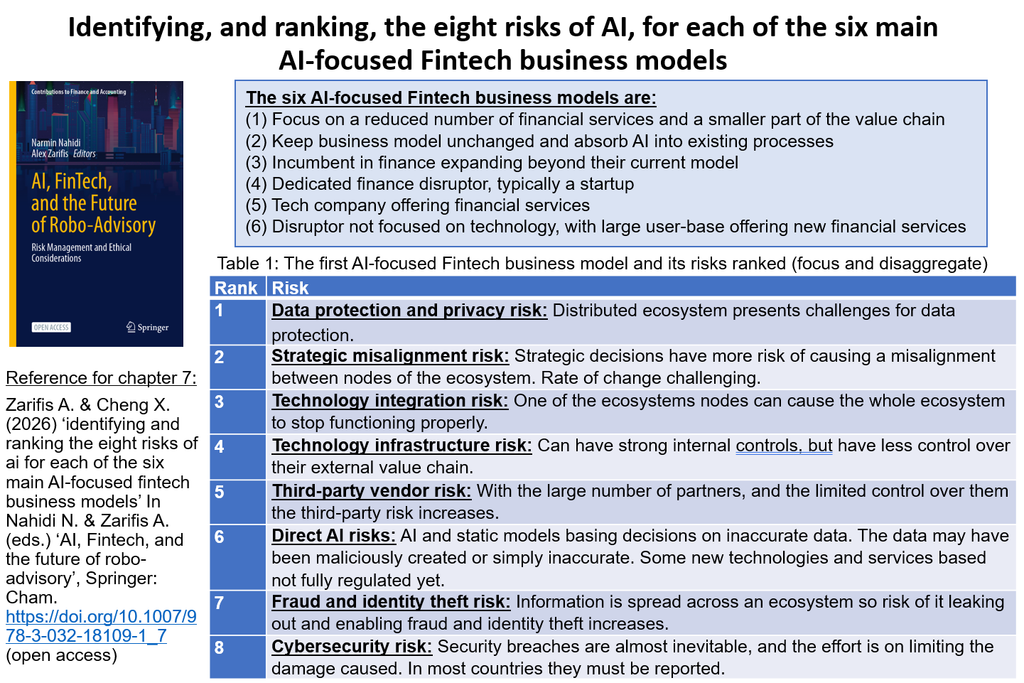
Table 1. The first AI-focused Fintech business model and its risks ranked (focus and disaggregate)


The eight risks related to the application of an AI-focused business model identified are: (1) Direct AI risks, (2) technology integration risk, (3) third-party vendor risk, (4) technology infrastructure risk, (5) data protection and privacy risk, (6) cybersecurity risk, (7) fraud and identity theft risk, and finally (8) strategic misalignment risk. The eight risks apply to all six models, however, they are not equally significant in all models. For example, in table one we see the ranking of the eight risks for the first AI-focused business model.
The six business models reduce risk in two main ways: Firstly, because they are proven models, and secondly because they have a proven place in the emerging financial ecosystem.
While the Fintech business models do not necessarily increase risk, and may indeed reduce it, because of the change in the nature of the risk involved, trust needs to be built with all the stakeholders.
These are the main findings of this research.

Reference for chapter 7:
Zarifis A. & Cheng X. (2026) ‘Identifying and ranking the eight risks of AI for each of the six main AI-focused Fintech business models’ In Nahidi N. & Zarifis A. (eds.) ‘AI, Fintech, and the future of robo-advisory’, Springer: Cham. https://doi.org/10.1007/978-3-032-18109-1_7 (open access)
Most financial institutions can meet their short-term targets by offering attractive services. However, the best financial institutions go beyond that, and build strong relationships. Both retail customers and organizations, show trust and loyalty to financial institutions they have a stronger bond with. Before the internet, this happened naturally with the face-to-face interaction. Even when we interacted with a company’s systems on the internet, until recently, these systems did not use AI, but human logic coded into them. Now, with the prevalence of AI and financial robo-advisory, new ways are needed to build trust.
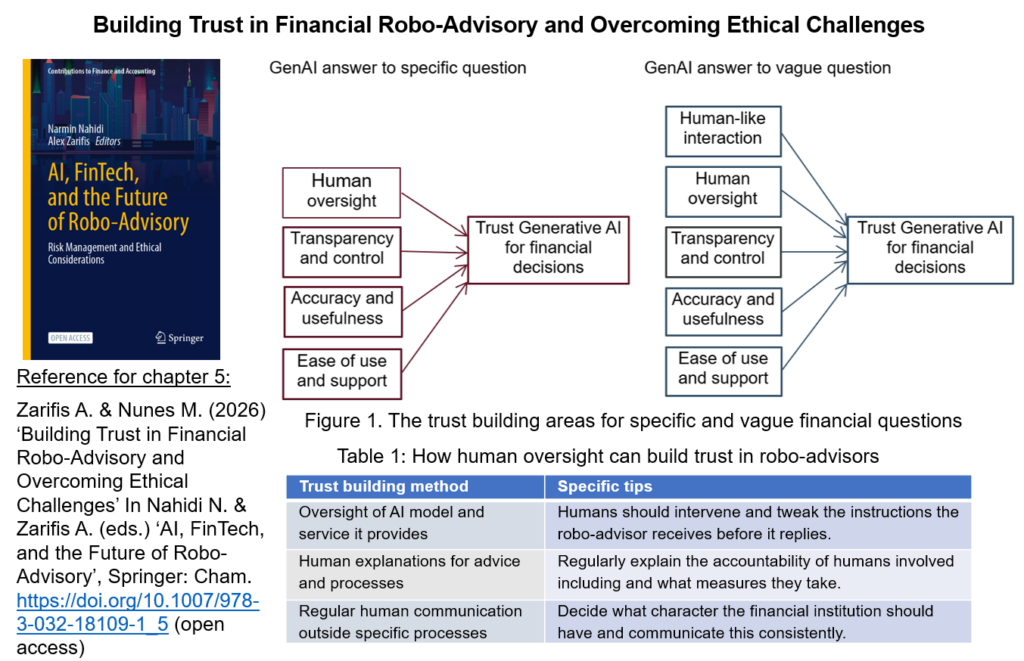
Previous research identified five areas where trust could be built for financial robo-advisors, as illustrated in figure 1. These are building trust with human oversight, with transparency and control, with accuracy and usefulness, by making things easy to use, and finally with a humanlike interaction. This research identifies the specific methods for building trust, for each of these five areas.

Figure 1, the trust building areas for specific and vague financial questions and table 1, building trust with human oversight

Previous research identified five areas where trust could be built for financial robo-advisors, as illustrated in figure 1. This research identifies the specific methods for building trust, for each of these five areas. For example, as illustrated in table 1, building trust with human oversight can be done in three specific ways: (1) Oversight of AI model and service it provides, (2) human explanations for advice and processes, and (3) regular human communication outside specific processes.
Building trust with transparency and control can be done by: (1) Recognizing that there are beliefs that do not immediately lead to action, so following the current data will not give us all the answers, (2) explain actions and demonstrating ability and integrity, and (3) balance automation with control to avoid disempowering users.
Building trust with accuracy and usefulness can be done by having: (1) Accurate and relevant information conveying competence and integrity, (2) useful functionality supported by extensive testing, and multiple methods, and (3) enhanced usefulness through personalisation.
Building trust by making things easy to use can be done by: (1) Making everything easy to use while keeping all the necessary functionality, (2) support time management with nudges, and (3) having a useful and reliable service with high performance.
Building trust with a humanlike interaction can be done by: (1) Utilizing the latest sentiment analysis, and longest contextual memory, (2) the robo-advisor should have a clear persona, and (3) build a relationship, and a feeling of friendship and partnership.

Reference for chapter 5:
Zarifis A. & Nunes M. (2026) ‘Building Trust in Financial Robo-Advisory and Overcoming Ethical Challenges’ In Nahidi N. & Zarifis A. (eds.) ‘AI, FinTech, and the Future of Robo-Advisory’, Springer: Cham. https://doi.org/10.1007/978-3-032-18109-1_5 (open access)

Among the many Fintech innovations, robo-advisors offering algorithm-based financial planning and investment services are rapidly rising to prominence. Their emergence signals a shift not only in how financial advice is delivered, but also in the broader relationship between finance, technology, and society.
Robo-advisors are digital platforms that offer investment advice and typically create customized portfolios for individuals based on their preferences. These automated investment advisors are guiding an increasing volume of people and resources. They are growing in their ability and influence. The AI used can draw on a huge breadth of data and identify patterns that a human would miss, and may even defy a rational explanation. Despite the potential they have, in practice, customization is often limited and the investors are simply put in a number of categories based on their dispositions to risk and their goals. The state of the art of what AI can do in this context and what is offered can be quite different, with some simpler services riding the wave of popularity of AI.
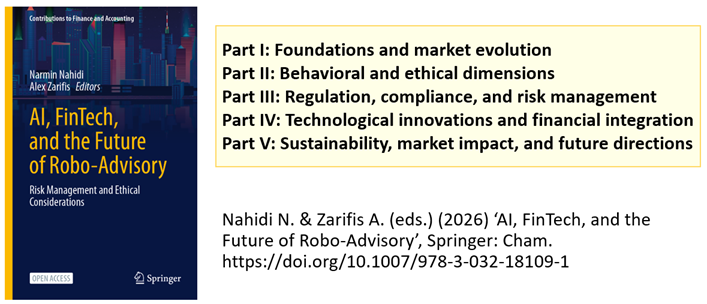
This book covers the key issues related to robo-advisors covering both the financial and technological dimensions. It has five parts and 15 chapter covering many different aspects of this solution. The first part is on the foundations and market evolution, the second covers behavioural and ethical dimensions, the third discusses regulation, compliance, and risk management, then we look at technological innovations and financial integration, and finally, we explore sustainability, market impact, and future directions.

Using robo-advisors effectively may involve using the latest versions of generative AI or applying completely commoditized solutions with an effective business model. There isn’t one answer, but it is necessary to understand this service and more broadly the role of Fintech in disrupting finance. To be successful, those coming from finance must understand robo-advisors as a technology and as an innovation, while people from a technology background must understand the financial dimension. In addition to the typical service of portfolio management, other common services are retirement planning, financial planning tools, fractional share investing, thematic and ESG investing, dividend reinvestment, crypto investments, estate planning, insurance advice and debt management.

Reference for book:
Nahidi N. & Zarifis A. (eds.) (2026) ‘AI, FinTech, and the Future of Robo-Advisory’, Springer: Cham. https://doi.org/10.1007/978-3-032-18109-1 (open access)


Reference for first chapter:
Zarifis A., Nahidi N. & Yarovaya L. (2026) ‘The Rise of Robo-Advisory in FinTech’ In Nahidi N. & Zarifis A. (eds.) ‘AI, FinTech, and the Future of Robo-Advisory’, Springer: Cham. https://doi.org/10.1007/978-3-032-18109-1_1 (open access)