Among the many Fintech innovations, robo-advisors offering algorithm-based financial planning and investment services are rapidly rising to prominence. Their emergence signals a shift not only in how financial advice is delivered, but also in the broader relationship between finance, technology, and society.
Robo-advisors are digital platforms that offer investment advice and typically create customized portfolios for individuals based on their preferences. These automated investment advisors are guiding an increasing volume of people and resources. They are growing in their ability and influence. The AI used can draw on a huge breadth of data and identify patterns that a human would miss, and may even defy a rational explanation. Despite the potential they have, in practice, customization is often limited and the investors are simply put in a number of categories based on their dispositions to risk and their goals. The state of the art of what AI can do in this context and what is offered can be quite different, with some simpler services riding the wave of popularity of AI.
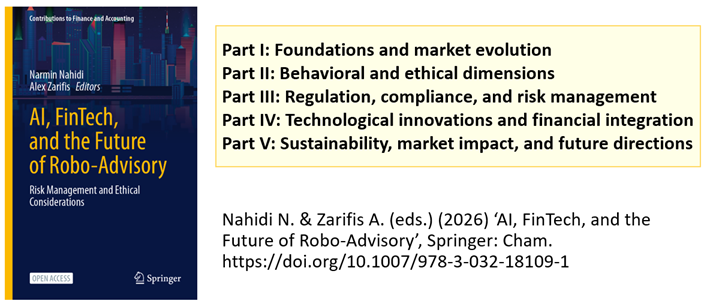
This book covers the key issues related to robo-advisors covering both the financial and technological dimensions. It has five parts and 15 chapter covering many different aspects of this solution. The first part is on the foundations and market evolution, the second covers behavioural and ethical dimensions, the third discusses regulation, compliance, and risk management, then we look at technological innovations and financial integration, and finally, we explore sustainability, market impact, and future directions.
Using robo-advisors effectively may involve using the latest versions of generative AI or applying completely commoditized solutions with an effective business model. There isn’t one answer, but it is necessary to understand this service and more broadly the role of Fintech in disrupting finance. To be successful, those coming from finance must understand robo-advisors as a technology and as an innovation, while people from a technology background must understand the financial dimension. In addition to the typical service of portfolio management, other common services are retirement planning, financial planning tools, fractional share investing, thematic and ESG investing, dividend reinvestment, crypto investments, estate planning, insurance advice and debt management.
Reference for book:
Nahidi N. & Zarifis A. (eds.) (2026) ‘AI, FinTech, and the Future of Robo-Advisory’, Springer: Cham. https://doi.org/10.1007/978-3-032-18109-1 (open access)
Reference for first chapter:
Zarifis A., Nahidi N. & Yarovaya L. (2026) ‘The Rise of Robo-Advisory in FinTech’ In Nahidi N. & Zarifis A. (eds.) ‘AI, FinTech, and the Future of Robo-Advisory’, Springer: Cham. https://doi.org/10.1007/978-3-032-18109-1_1 (open access)