Most financial institutions can meet their short-term targets by offering attractive services. However, the best financial institutions go beyond that, and build strong relationships. Both retail customers and organizations, show trust and loyalty to financial institutions they have a stronger bond with. Before the internet, this happened naturally with the face-to-face interaction. Even when we interacted with a company’s systems on the internet, until recently, these systems did not use AI, but human logic coded into them. Now, with the prevalence of AI and financial robo-advisory, new ways are needed to build trust.
Previous research identified five areas where trust could be built for financial robo-advisors, as illustrated in figure 1. These are building trust with human oversight, with transparency and control, with accuracy and usefulness, by making things easy to use, and finally with a humanlike interaction. This research identifies the specific methods for building trust, for each of these five areas.
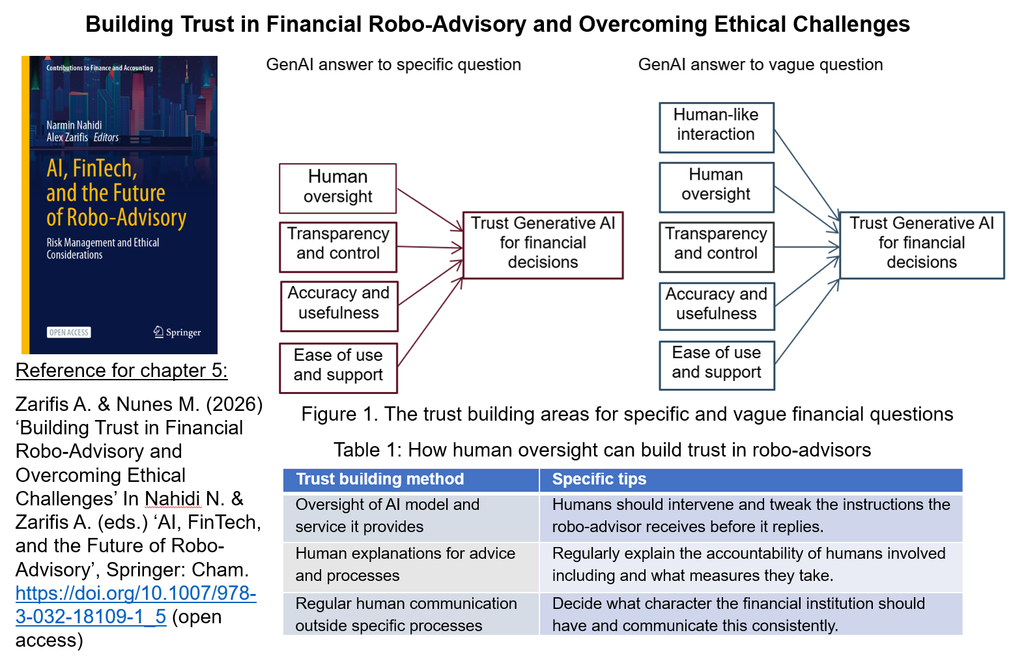
Figure 1, the trust building areas for specific and vague financial questions and table 1, building trust with human oversight
Previous research identified five areas where trust could be built for financial robo-advisors, as illustrated in figure 1. This research identifies the specific methods for building trust, for each of these five areas. For example, as illustrated in table 1, building trust with human oversight can be done in three specific ways: (1) Oversight of AI model and service it provides, (2) human explanations for advice and processes, and (3) regular human communication outside specific processes.
Building trust with transparency and control can be done by: (1) Recognizing that there are beliefs that do not immediately lead to action, so following the current data will not give us all the answers, (2) explain actions and demonstrating ability and integrity, and (3) balance automation with control to avoid disempowering users.
Building trust with accuracy and usefulness can be done by having: (1) Accurate and relevant information conveying competence and integrity, (2) useful functionality supported by extensive testing, and multiple methods, and (3) enhanced usefulness through personalisation.
Building trust by making things easy to use can be done by: (1) Making everything easy to use while keeping all the necessary functionality, (2) support time management with nudges, and (3) having a useful and reliable service with high performance.
Building trust with a humanlike interaction can be done by: (1) Utilizing the latest sentiment analysis, and longest contextual memory, (2) the robo-advisor should have a clear persona, and (3) build a relationship, and a feeling of friendship and partnership.
Reference for chapter 5:
Zarifis A. & Nunes M. (2026) ‘Building Trust in Financial Robo-Advisory and Overcoming Ethical Challenges’ In Nahidi N. & Zarifis A. (eds.) ‘AI, FinTech, and the Future of Robo-Advisory’, Springer: Cham. https://doi.org/10.1007/978-3-032-18109-1_5 (open access)