Managing project teams virtually can create difficulties for leaders. Some online projects have a low level of challenge and require less from a leader, while more challenging online projects can require far more. There are several leadership styles, with different benefits, that can be chosen for each context and the difficulties it presents. The leadership style that is most effective for challenging virtual teams was not clear.
This research evaluates the two most popular leadership styles, transformational and transactional, in virtual projects for both a low level of challenge, and a high level of challenge.
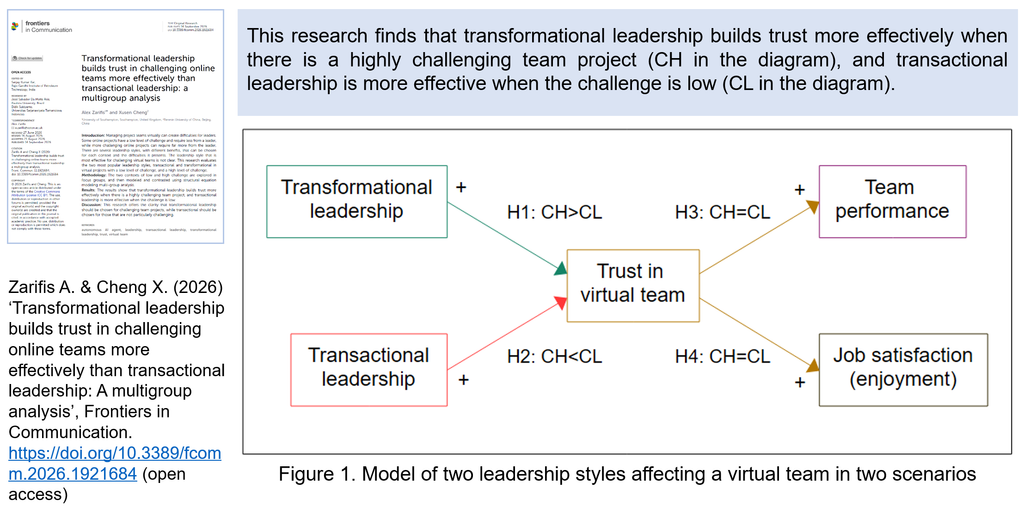

The results show that transformational leadership builds trust more effectively when there is a highly challenging team project, and transactional leadership is more effective when the challenge is low. Therefore, the leader should adapt their style depending on how challenging the virtual team project is.
A strength compared to previous research is that the whole model is contrasted in two contexts which is superior statistically to just comparing some isolated variables in two contexts. The model proves the relationship between transformational leadership, transactional leadership, trust in the team, team performance, and job satisfaction. The model also validates the new, clear, definitions for virtual teams with a low or high challenge. (1) A virtual team project with a low level of challenge has high stability, low intention of turnover, strong communication and strong engagement. (2) A virtual team with a high level of challenge is less stable with a higher intention of turnover, weak communication, and weak engagement.
There are several reasons why in challenging times with a high degree of uncertainty, a people focused leadership is more effective at building trust and overcoming the challenges. Motivating and building commitment become more important. The cost-benefit logic of transactional leadership does not encourage workers to go beyond their tasks and find the innovative solutions necessary. Transformational leadership on the other hand inspires workers to overcome new ill-defined challenges and improve themselves. Put simplistically, teams facing challenges and instability need a visionary leader, not an administrator.

Reference
Zarifis A. & Cheng X. (2026) ‘Transformational leadership builds trust in challenging online teams more effectively than transactional leadership: A multigroup analysis’, Frontiers in Communication. https://doi.org/10.3389/fcomm.2026.1921684 (open access)
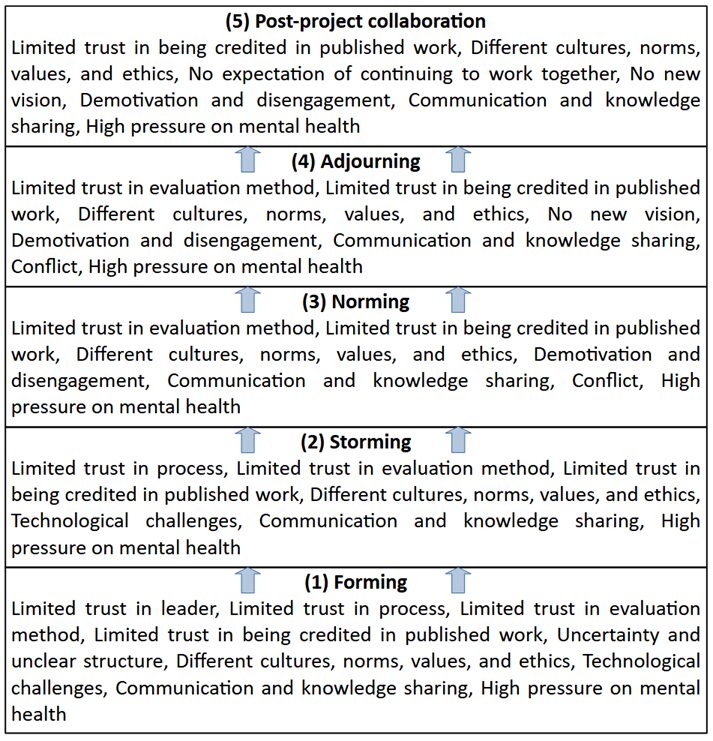
There are many benefits for researchers that take part in a project but there are also several challenges that can create a cumulative, negative, effect on their mental health. This research identifies the challenges researchers face in projects, so that the leader of the project can reduce them as far as possible.

Existing research focuses on four stages of a project: Forming, Storming, Norming and Adjourning. This research adds a fifth stage, Post-Project Collaboration, as this stage is implicitly or explicitly a part of most research projects. For example, a post-doctoral researcher expects to be credited for their work even if it is published after the end of the project. The specific challenges for each of the five stages are identified. This enables the leader to focus on a manageable number of challenges at each stage.

Some challenges are in only in one stage of the process, while other challenges are across several stages. It is notable that there is no conflict at the start, but trust is a challenge at the start. This suggests that low trust at the start causes problems later. Therefore, there is a delayed reaction, and once the conflict happens it might be too late, as the trust should have been built earlier.

Figure 1: A model for reducing the challenges for researchers in projects across five stages

Trust is important in several collaboration settings, particularly at the start, until participants familiarise themselves with each other and the project team matures. In research teams, due to the long period of time until the research is published, often over five years, there is an additional, long-term cause for risk and distrust that is only resolved once the research is published.

Trust should be built during the first stage to cover four specific topics: Trust in the leader, process, evaluation method, and trust in being credited in published work.

In the final two stages of the project, adjourning and post-project collaboration, a new vision needs to be communicated effectively as the original vision stops resonating after the norming stage.

For those challenges that cannot be solved outright, the leader of the research project must show an awareness. The leader should be ambidextrous, in the sense of focusing on the project deliverables and the socio-psychological aspects of the teamwork.

Reference

Zarifis A. & Cheng X. (2024) ‘A model reducing researchers’ challenges in projects: build trust first for better mental health’, Cogent Business & Management, vol.11., no.1, pp.1-13. https://doi.org/10.1080/23311975.2024.2350786 (open access)